Trenton is New Jersey's capital — a Delaware River city whose residential neighborhoods span nearly 300 years of American architecture. The Colonial-era homes of Mill Hill, one of the oldest residential neighborhoods in New Jersey. The Victorian and Italianate homes of the Chambersburg and South Trenton neighborhoods, built during the city's pottery and wire rope manufacturing heyday. The brick colonials and Capes of Hamilton, Ewing, and Lawrence — Mercer County's mid-century suburban communities. And the newer construction spreading through Princeton Junction and West Windsor. Since 2004, Shamrock Chimney has served all of Trenton with CSIA certified expertise adapted to the capital region's extraordinary range of construction eras and the Delaware Valley's challenging climate.
Honest Chimney Service for the Capital Region
Trenton homeowners are practical people who value straightforward service. Our veteran-founded company delivers exactly that. Camera footage from inside your flue. Written report with photos. Honest assessment of what needs attention and what doesn't. No pressure. No inflated estimates. If your Trenton chimney is sound, we say so. When something needs repair, we explain the issue, the options, and the cost — then let you decide. Two decades of referrals across Mercer County prove this approach works.
Every Trenton Chimney Type — Three Centuries of Expertise
Trenton's housing stock spans nearly 300 years, and our technicians service chimneys from every era. Colonial-era stone and brick fireplaces in Mill Hill and the historic district. Victorian multi-flue configurations in Chambersburg. Traditional masonry chimneys on mid-century colonials in Hamilton and Ewing. Factory-built metal flue systems in newer Lawrence and West Windsor construction. Gas fireplace inserts standard in recent builds. Oil furnace flues still common in older Trenton homes. And the specialized chimney systems found in converted industrial buildings near the Delaware waterfront. Three centuries of construction in one service area.
Trenton's Most Popular Service: Sweep & Inspection
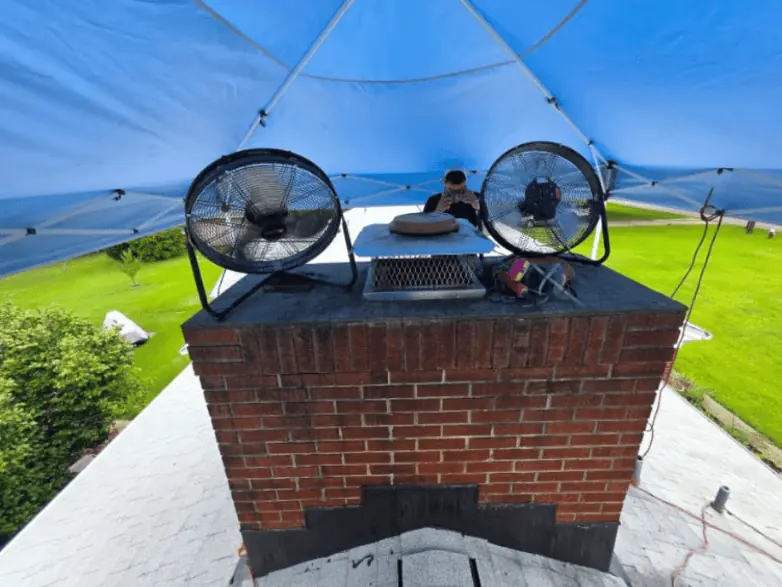
Most Trenton homeowners start with our combined sweep and inspection — one visit, flat pricing, complete coverage. We clean your flue using professional rotary equipment with HEPA-filtered vacuums, then inspect every component: firebox, damper, smoke chamber, liner, crown, cap, and flashing. Camera footage documents the interior. A written report with photos goes home with you. For Mercer County real estate transactions, Level 2 inspections satisfy lender requirements with fast turnaround.
Trenton Masonry: Delaware River Humidity Meets Northeast Winter
Trenton's chimney masonry faces challenges amplified by the Delaware River corridor. River humidity keeps masonry saturated during warmer months. Northeast storms driven by coastal weather systems deliver 47+ inches of annual precipitation. Winter produces 50-65 freeze-thaw cycles that crack moisture-laden brick and mortar. And Trenton's oldest chimneys — some approaching 250 years old — were built with materials and techniques from a completely different era. Our masonry crew addresses this full range: lime-based mortars compatible with Colonial-era construction, period-appropriate brick matching for Victorian homes, and modern cold-climate formulations for mid-century and newer structures.
Annual Chimney Service: Essential for the Capital Region
The Delaware Valley's climate creates year-round chimney demands. Summer humidity from the river corridor saturates masonry and promotes mold inside dormant flues. Fall brings animal nesting — Trenton's urban wildlife targets uncapped chimneys aggressively. Winter's freeze-thaw cycles crack moisture-laden masonry. Spring thunderstorms test every seal and surface. And Trenton's clay soil shifts with moisture changes, stressing chimney foundations. Annual professional inspection catches cumulative damage before it compounds.
Creosote in Trenton: Northeast Winters and Delaware Valley Humidity
Trenton's four-to-five month heating season (November through March) produces meaningful creosote accumulation for wood-burning homeowners. Northeast cold creates condensation inside the flue as warm combustion gases meet cold chimney walls. Delaware River humidity adds moisture to combustion gases, making the resulting deposits stickier. Over a full Central Jersey heating season, active fireplaces can exceed the NFPA's 1/8-inch hazard threshold. Annual sweeping eliminates the fire risk completely.
Water and CO: Central Jersey's Hidden Chimney Threats
Water causes more cumulative chimney damage in Trenton than fire. The Delaware Valley receives 47+ inches of annual precipitation. River humidity keeps masonry saturated. Clay soil movement opens gaps at chimney bases. Inside the chimney, water rusts dampers, erodes mortar, promotes mold, and through freeze-thaw, progressively destroys masonry. Carbon monoxide from gas and oil appliances is the most immediately lethal threat — any chimney venting combustion gases must maintain an intact pathway. Our inspections evaluate both threats systematically.