Gas Logs
Hand-painted ceramic gas log sets that transform your existing fireplace into an instant-on fire — realistic flames, zero mess, and no chimney sweeping required
What's Included
Gas log sets are the simplest and most affordable way to enjoy fire in your existing masonry fireplace without the hassle of wood. Hand-painted ceramic or refractory cement logs sit atop a precisely engineered burner that produces realistic yellow flames with glowing ember beds. Available in vented configurations (damper open, most realistic flames) and vent-free configurations (damper closed, maximum heat output), gas logs deliver instant ambiance at the flip of a switch or touch of a remote. Shamrock Chimney handles complete installation including gas line connection, burner fitting, log placement for proper flame pattern, and chimney inspection for vented installations.
Gas Logs: The Simplest Way to Enjoy Fire in Your Existing Fireplace
If you love the look of a fire but not the work that goes with it — hauling firewood, building and tending the fire, cleaning ash, sweeping the chimney — gas logs are your solution. A quality gas log set transforms your existing masonry fireplace into an instant-on, zero-maintenance fire feature that looks remarkably like the real thing. Flip a switch, and within seconds you have dancing yellow flames, glowing embers, and the warm ambiance of a fire — without a single piece of firewood.
Vented vs. Vent-Free: Understanding Your Options
The single most important decision when choosing gas logs is whether to go vented or vent-free. Each has distinct advantages:
Vented Gas Logs
Vented gas logs are designed to be used with your fireplace damper open, allowing combustion gases to exit through your chimney — exactly like a wood fire. This is the configuration we recommend for most homeowners, and here’s why:
- Most realistic flames: Vented burners produce tall, yellow, dancing flames that are virtually indistinguishable from a real wood fire. The open damper creates natural draft that makes flames dance and flicker naturally.
- No indoor air quality impact: All combustion byproducts — including carbon monoxide, water vapor, and nitrogen oxides — exit through your chimney.
- No room size restrictions: Vented logs can be used in any room regardless of size.
- Safest option: With the damper open and chimney functioning, there’s minimal risk of combustion gas buildup.
The tradeoff: most heat goes up the chimney (similar to a wood fire). Vented gas logs are primarily an ambiance feature, not a heating appliance.
Vent-Free Gas Logs
Vent-free gas logs operate with your damper closed (or partially closed), keeping heat in the room. They’re legitimate supplemental heaters:
- High efficiency: 99%+ of the fuel’s heat stays in your room — nothing goes up the chimney.
- Significant heat output: 20,000-40,000 BTUs depending on model — enough to noticeably heat a living room.
- No chimney required: Can be used in fireplaces with non-functional chimneys (though we still recommend inspection).
The tradeoffs: smaller, bluer flames that are less realistic than vented logs. Combustion products (including water vapor and trace CO) enter your room. Room size minimums apply — typically 150-300 sq ft minimum depending on BTU rating. Some states and municipalities restrict or prohibit vent-free gas appliances. An oxygen depletion sensor (ODS) automatically shuts off the burner if oxygen levels drop below safe thresholds.
Choosing the Right Log Set
Gas log sets come in multiple sizes, species, and configurations. Here’s how to choose:
Size
Gas logs are measured by width — matching your fireplace opening. Standard sizes range from 18 to 30 inches. We measure your firebox width, depth, and height to determine the maximum log size that fits safely with required clearances. Logs that touch firebox walls create hot spots and potential safety hazards. Properly sized logs sit centered in the firebox with clearance on all sides.
Log Species and Style
Hand-painted ceramic logs are available in numerous wood species, each with distinctive appearance:
- Oak: The most popular choice. Deeply textured bark, realistic split-wood detail, and warm brown tones.
- Birch: Distinctive white bark with dark accent marks. Creates a bright, elegant appearance.
- Driftwood: Weathered, sun-bleached appearance. Popular for coastal and contemporary interiors.
- Charred oak: Pre-charred appearance that looks like a fire that’s been burning for hours. Extremely realistic.
- Mixed species: Combination sets with different log sizes and types for the most natural appearance.
Premium manufacturers like Real Fyre and Rasmussen hand-paint each log individually, creating subtle color variations that make every set unique — just like real wood.
Ignition Systems
Gas logs offer four ignition options, each at a different price point and convenience level:
- Match light: The simplest and least expensive option. You manually light the burner with a long match or lighter. No standing pilot, no electricity, no remote. Turn the gas on, light it, turn the gas off when done.
- Safety pilot: A small pilot flame stays lit continuously. Turn the burner on and off with a gas valve knob next to the fireplace or with a wall switch. Reliable and simple — no electricity required.
- Electronic ignition: No standing pilot — the burner ignites on demand with an electric spark. Saves $10-15/month in pilot gas. Operated by wall switch or remote control. Requires electricity.
- Remote control with thermostat: Full remote operation with flame height adjustment and thermostat temperature control. The most convenient option. Some models include timers for automatic on/off scheduling.
What Professional Installation Includes
Proper gas log installation is critical for safety and performance. Our CSIA certified installation includes:
- Chimney inspection (vented installations): We verify your chimney is functional, the damper operates properly, and the flue is clear of obstructions. Gas logs require a working chimney with adequate draft.
- Gas line connection: Proper sizing and connection of gas supply to the burner. We use approved flexible gas connectors with proper shutoff valves accessible from the firebox.
- Burner installation: The burner is positioned and leveled in the firebox per manufacturer specifications. Proper positioning ensures even gas distribution and optimal flame pattern.
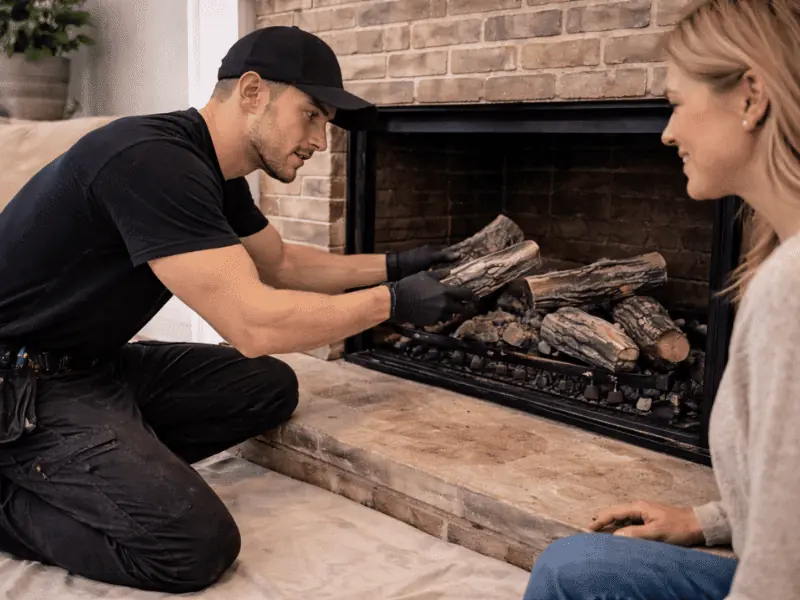
- Log placement: This is where expertise matters most. Each log must be positioned precisely per the manufacturer’s placement diagram. Incorrect log placement causes uneven flames, sooting, poor combustion, and potential carbon monoxide production. Our technicians follow manufacturer diagrams exactly and verify flame pattern after placement.
- Safety testing: Gas leak detection at every connection point, flame pattern verification, draft testing (vented), and operational checkout of all controls.
- Operational training: We demonstrate proper use, explain when to have the damper open vs. closed (critical for vented logs), and review annual maintenance requirements.
Why Log Placement Matters More Than You Think
The most common gas log problem we see is improper log placement — either from DIY installation or from logs being moved during cleaning. Each log in the set has a specific position, angle, and orientation designed by the manufacturer to work with the burner’s flame ports. When logs are moved out of position:
- Flames impinge directly on ceramic surfaces, causing sooting
- Gas flow patterns are disrupted, creating uneven combustion
- Incomplete combustion can produce elevated carbon monoxide levels
- The visual effect suffers — flames look unnatural and unbalanced
Our installation includes precise manufacturer-specified placement, and we encourage homeowners to photograph their log arrangement for reference if logs are ever moved for cleaning.
Maintenance Requirements
Gas logs are low-maintenance but not no-maintenance:
- Annual inspection: Professional check of gas connections, burner condition, pilot assembly, log integrity, and (for vented) chimney draft. This annual service typically costs $150-$250.
- Glass cleaning: Fireplace glass develops a film from combustion deposits. Clean with gas fireplace glass cleaner (never standard glass cleaner) as needed.
- Log inspection: Check logs annually for cracks or deterioration. Damaged logs should be replaced promptly — cracked ceramic can alter flame patterns.
- Pilot maintenance: Safety pilot assemblies accumulate dust and spider webs during off-season. Pre-season cleaning ensures reliable ignition when you’re ready to use your logs.
Gas Logs vs. Gas Inserts: What’s the Difference?
Gas logs sit inside your existing open fireplace — you can still see the firebox walls and the fire looks like a traditional hearth fire. A gas fireplace insert is a sealed combustion appliance that slides into your firebox, enclosing the entire opening. The key differences:
- Cost: Gas logs ($800-$2,500) vs. inserts ($2,500-$5,500)
- Heating: Logs are primarily decorative; inserts are efficient heaters
- Appearance: Logs maintain your fireplace’s original open-hearth look; inserts look like a self-contained appliance
- Efficiency: Vented logs send most heat up the chimney; inserts capture 75-85% of heat
If your priority is ambiance and maintaining your fireplace’s traditional appearance, gas logs are the right choice. If your priority is efficient heating, consider a gas insert.
Brands We Carry
Real Fyre — The industry standard for realistic hand-painted ceramic logs with the widest variety of species and sizes
Rasmussen — Premium hand-crafted logs with steel-rod reinforced construction for maximum durability and realism
Monessen — Complete log and burner systems with excellent flame presentation at competitive pricing
Empire — American manufacturer with vented and vent-free options including remote and thermostat control
Golden Blount — Texas-crafted logs with Burnt Mountain Oak and other exclusive designs unavailable elsewhere
Need Installation or Service?
Our CSIA certified technicians handle professional installation and ongoing maintenance.
Why Buy From Shamrock Chimney?
More than just sales – complete solutions from experts
CSIA Certified
Our technicians are certified by the Chimney Safety Institute of America.
Professional Installation
We don't just sell – we install, inspect, and ensure everything is code compliant.
Warranty Support
Full manufacturer warranties honored, plus our workmanship guarantee.